Related Articles
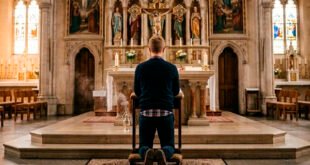


We live in times of confusion. Moral crisis, political instability, attacks on the faith, doctrinal relativism, the trivialization of evil. Many Christians ask: Are we near the end? Is the world out of control?
Yet almost two thousand years ago, Saint Paul wrote something that dramatically illuminates our era. In his Second Letter to the Thessalonians, he speaks of a troubling mystery: the Katechon, “that which restrains” the full manifestation of the Antichrist.
“And now you know what is restraining him, so that he may be revealed in his time. For the mystery of lawlessness is already at work; only he who now restrains it will do so until he is taken out of the way.” (2 Thess 2:6–7)
These words are brief… but explosive.
Today we will delve with theological rigor and pastoral sensitivity into this fascinating concept, in order to understand not only what the Katechon is, but what it means for our Christian life in the 21st century.
I. The Biblical Text: A Veiled Revelation
In chapter 2 of 2 Thessalonians, Saint Paul corrects an eschatological confusion: some believed that the “Day of the Lord” had already arrived. The Apostle clarifies that certain events must occur first:
- The apostasy.
- The manifestation of the “man of lawlessness.”
- The removal of “the one who restrains.”
Here appears the Greek term τὸ κατέχον (to katéchon) and also ὁ κατέχων (ho katéchon) — in the neuter and in the masculine — suggesting that it could refer either to a force or to a person.
And here the mystery begins.
II. What Is the Katechon? Interpretations in Tradition
The Church has never dogmatically defined what the Katechon is. But Tradition has offered solid interpretations.
1. The Roman Empire: Order That Restrains Chaos
Fathers such as Tertullian and John Chrysostom identified the Katechon with the Roman Empire.
Why?
Because the Empire represented juridical and political order that prevented total anarchy. When that order collapsed, the stage would be set for a universal tyrannical figure.
This was not an ideological defense of Rome, but a profound intuition:
evil needs chaos in order to manifest itself fully.
2. The Principle of Legitimate Authority
Over the centuries, theologians broadened the interpretation: it would not be Rome alone, but the very principle of authority that sustains natural and social order.
Where legitimate authority disappears, the vacuum does not remain neutral: disordered power fills it.
3. The Church as a Spiritual Restraint
Other authors have seen in the Katechon the Church herself: the Mystical Body of Christ who, through her preaching, sacraments, and moral witness, restrains the total expansion of evil.
As long as the Church proclaims the truth, celebrates the Eucharist, and forms consciences, the “mystery of lawlessness” cannot unfold without resistance.
4. The Holy Spirit Acting in History
Some theologians identify the Katechon with the provident action of the Holy Spirit, who limits evil until the moment determined by God.
This interpretation underscores something essential:
history is not out of control. It is under divine sovereignty.
III. The Mystery of Lawlessness: Already at Work
Saint Paul is clear:
“The mystery of lawlessness is already at work.”
This means that evil does not appear suddenly in the visible form of the Antichrist. It operates progressively, like a hidden fermentation.
Apostasy does not begin with frontal denial, but with:
- relativizing truth,
- loss of the sense of sin,
- trivialization of the sacred,
- weakening of authority,
- doctrinal confusion.
Does that sound familiar?
But here is the theological key:
Evil is already at work, but it cannot fully manifest itself because it is being restrained.
Evil has limits. It is measured. It is contained.
IV. Theological Rigor: Divine Sovereignty and the Economy of Evil
From a strictly theological perspective, the Katechon reveals a central truth:
God permits evil, but He limits it.
Saint Thomas Aquinas teaches that God does not cause evil, but permits it in order to draw a greater good from it. The Katechon is a historical expression of that providential economy.
The Antichrist does not appear when he wishes.
He appears when God allows it.
And that completely changes our perspective:
We do not live in a universe governed by chaotic forces, but in a history directed toward an outcome willed by God.
V. The Katechon and Our Time
Many today observe:
- crisis of Christian identity,
- weakening of traditional structures,
- cultural persecution of the faith,
- constant moral redefinition.
Faced with this, two temptations arise:
- Apocalyptic alarmism.
- Spiritual indifference.
The Katechon protects us from both.
It tells us:
- Evil is not all-powerful.
- But neither is it nonexistent.
- It is growing.
- It is being restrained.
The question is not only what is the Katechon, but:
What happens when it weakens?
When authority is corrupted, when the Church loses fervor, when Christians grow complacent… the restraint loosens.
VI. Pastoral Dimension: The Katechon in Your Life
Here is what matters most.
Beyond historical or political interpretations, the Katechon has a profoundly spiritual dimension.
In every soul there is something that restrains the advance of evil:
- sanctifying grace,
- sacramental life,
- constant prayer,
- a rightly formed conscience.
When we neglect confession, the Eucharist, solid doctrine… the “mystery of lawlessness” encounters less resistance within us.
In this sense, every Christian can become a small “katechon.”
When:
- you pray the Rosary,
- you educate your children in truth,
- you defend life,
- you remain faithful to doctrine,
- you live in a state of grace,
you are mysteriously participating in the restraint of evil.
VII. Practical Applications for Today
How do we live in light of the Katechon?
1. Strengthen Your Sacramental Life
Frequent confession. Reverent Eucharist. Without grace, there is no resistance.
2. Form Your Intellect
Study the faith. Know the Catechism. Doctrinal error is one of the gateways of the “mystery of lawlessness.”
3. Defend the Natural Order
The family, legitimate authority, the moral law are not outdated structures: they are walls of containment.
4. Do Not Live in Fear
The Antichrist is not the protagonist of history. Christ is.
5. Persevere
Evil may seem to advance, but it does not have the final word.
VIII. An Unconquerable Hope
The Katechon reminds us of something extraordinary:
Evil is growing…
but it is being restrained.
And when that restraint is removed, it will not be the triumph of evil, but the fulfillment of the divine plan culminating in the glorious Parousia of Christ.
History does not end in darkness.
It ends in judgment, justice, and glory.
Conclusion: You Are Also Part of the Restraint
The Katechon is not merely an obscure theological concept.
It is a call.
A call not to surrender.
Not to grow lukewarm.
Not to collaborate with chaos.
Perhaps we will never know with certainty what or who the Katechon is on the historical plane.
But we do know something with absolute certainty:
Every time you choose truth over falsehood,
purity over sin,
fidelity over betrayal,
you participate in that mystery that restrains lawlessness.
And as long as there are faithful souls,
as long as there are holy priests,
as long as there are families who pray,
evil will encounter resistance.
Because history does not belong to the Antichrist.
It belongs to Christ.
And He has already won.