Related Articles
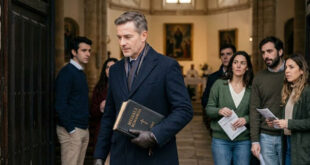


In a century marked by totalitarian ideologies, world wars, and a profound spiritual crisis, God raised up luminous witnesses. One of them was Saint Titus Brandsma, Carmelite, journalist, university professor, and martyr of Nazism. His life is a silent cry that pierces through time: evil can be resisted without hatred, truth can be defended without violence, one can die while forgiving.
Today, when truth is once again manipulated, when religious freedom is questioned, and when many Christians feel pressured to silence their faith, the figure of Saint Titus becomes strikingly relevant.
This article is not merely a biography. It is an invitation. A spiritual guide. A call to coherence.
1. A Son of Carmel in Protestant Lands
Titus Brandsma was born in 1881 in the Netherlands, into a deeply Catholic farming family in a predominantly Protestant environment. From childhood he breathed a lived, concrete, sacrificial faith. It was not a cultural faith; it was a conscious one.
He entered the Carmelite Order and took the name Titus. Carmel, a school of prayer and contemplation, would mark his spirituality forever. His love for Saint Teresa of Ávila and Saint John of the Cross was not merely academic. He understood that mysticism is not escapism but depth; not flight from the world but a root from which to transform it.
Later he would become professor and rector at the Catholic University of Nijmegen. A brilliant intellectual, historian, philosopher, journalist. But above all: a priest.
2. When Truth Has a Price
In the 1930s, Nazism was spreading throughout Europe. In 1940, the Netherlands was invaded by the Germany of Adolf Hitler.
The regime demanded that Catholic newspapers publish Nazi propaganda. Titus, as ecclesiastical advisor to the Catholic press, conveyed the clear instruction of the bishops: do not collaborate with falsehood.
He knew what he was doing. He knew the consequences.
He was arrested in 1942. Interrogated. Humiliated. Transferred to several prisons until he arrived at the concentration camp of Dachau.
There, amid cold, hunger, and torture, he never ceased to be a priest. He heard confessions clandestinely. He encouraged prisoners. He prayed. He consoled.
On July 26, 1942, he was murdered by lethal injection.
But his death was not defeat. It was offering.
3. The Theology of His Martyrdom: Truth, Freedom, and Charity
The martyrdom of Saint Titus was not a political reaction. It was a theological consequence.
a) Truth Is Not Negotiable
Jesus says:
“The truth will set you free” (Jn 8:32).
Saint Titus understood that when the press systematically lies, the soul of a people becomes corrupted. Defending truth was an act of charity. Because falsehood does not merely deceive; it enslaves.
Today, in the era of post-truth, fake news, and ideological manipulation, his witness directly challenges journalists, communicators, and also every Christian who shares content without discernment.
Truth is not an opinion. It is a Person: Christ.
b) Christian Freedom in the Face of Totalitarianism
Nazism did not seek only to dominate territories; it sought to dominate consciences. Christianity affirms that conscience belongs to God.
Saint Titus did not die for a political ideology, but for the interior freedom that flows from the Gospel.
Saint Paul expressed it this way:
“For freedom Christ has set us free” (Gal 5:1).
Modern totalitarianism does not always wear a uniform. Sometimes it presents itself as political correctness, as cultural pressure, as social cancellation. But the principle is the same: to silence revealed truth.
Saint Titus teaches us that a Christian can lose everything… except interior freedom.
c) Heroic Charity: Forgiving the Executioner
One of the most moving episodes of his life occurred in Dachau. The nurse who administered the lethal injection later testified that Titus had given her his rosary and said:
“Pray for me.”
She was not Catholic. Years later, her testimony would contribute to his beatification cause.
Here lies the heart of Christianity. It is not resistance with hatred. It is resistance with charity.
Jesus said:
“Love your enemies” (Mt 5:44).
Saint Titus did not merely preach it. He lived it.
4. Carmel in the Concentration Camp
What is most impressive about his figure is that he never ceased to be contemplative.
Carmelite spirituality teaches that the soul can live united to God in the midst of suffering. Like Saint Thérèse of Lisieux, he understood that holiness is played out in the small, in the everyday, in the hidden.
In Dachau he wrote:
“I feel happy and at peace.”
How is this possible? Because his identity did not depend on external circumstances, but on his union with Christ crucified.
Here lies a key lesson for our time:
The Christian who does not cultivate an interior life will be swept away by any ideological wind.
5. Contemporary Relevance: What Does Saint Titus Brandsma Say to Us Today?
We live in an age where:
- Faith is ridiculed.
- Christians are pressured to silence convictions.
- Truth is relativized.
- Information is manipulated.
Saint Titus offers us three concrete paths:
1. Solid Formation
He was a serious intellectual. He did not improvise. Today the Catholic needs deep doctrinal formation in order not to be confused.
It is not enough to “feel” the faith. One must know it.
2. Public Coherence
He did not separate faith and life. He did not say: “My spirituality is private.” He understood that the Gospel has social consequences.
You, in your workplace, in your company, in your environment (especially if you have responsibility over others), can create a climate of truth and human dignity.
Holiness is also lived in management, in justice at work, in respect, in commercial honesty.
3. Deep Interior Life
Without prayer, there is no resistance. Without the sacraments, there is no perseverance.
Saint Titus resisted because he prayed.
6. A Pastoral Guide to Apply His Example Today
Here is a concrete proposal inspired by his life:
🕊 Practice Informational Discernment
Before sharing a piece of news, ask yourself:
- Is it true?
- Does it build up?
- Does it respect human dignity?
📖 Deepen in Doctrine
Dedicate weekly time to reading the Catechism or Carmelite spiritual texts.
🙏 Strengthen Your Prayer Life
Fifteen minutes of daily silence can transform your interior stability.
✝ Learn to Suffer as a Christian
Not every opposition is persecution, but every discomfort can be offered to God.
❤️ Forgive Actively
The Christian does not conquer by crushing. He conquers by loving.
7. Canonization and Legacy
Saint Titus was beatified by Pope John Paul II in 1985 and canonized by Pope Francis in 2022.
His canonization is not a political gesture. It is a prophetic message: the Church recognizes as a model the one who defended truth against modern totalitarianism.
He was not an activist. He was a committed contemplative.
Conclusion: Will We Be Comfortable Christians or Courageous Witnesses?
Saint Titus Brandsma asks us an uncomfortable question:
Do we remain silent to avoid problems?
Do we negotiate truth to preserve comfort?
Do we separate faith and life out of fear?
The world does not need aggressive Christians.
It needs coherent Christians.
Firm. Serene. Prayerful.
Martyrdom will not always be of blood.
Sometimes it will be of reputation.
Of mockery.
Of exclusion.
But Christ still says:
“Unless a grain of wheat falls into the earth and dies, it remains alone; but if it dies, it bears much fruit” (Jn 12:24).
Saint Titus fell in Dachau.
And his fruit continues to grow.
May his example help us live a deep, well-formed, and courageous faith.
A faith that does not shout, but neither hides.
A faith that loves truth more than comfort.
Because in the end, only truth saves.
And only love conquers.