Related Articles



In an age like ours—marked by uncertainty, moral relativism, and a crisis of faith—the figure of Tobiah shines with surprisingly contemporary force. His story, narrated in the Book of Tobit, is a jewel of biblical tradition that weaves together human drama, divine providence, angels, illness, marriage, exile, and healing. But above all, it is a school of faith lived in the ordinary.
Far from being an ancient tale disconnected from our reality, the story of Tobiah is profoundly modern. It speaks to us about how to live faithfully to God when everything seems to be against us; about how to build strong families in the midst of a hostile culture; about discerning God’s will in important decisions; and about how prayer, almsgiving, and purity of heart remain the true path to happiness.
1. Historical and Spiritual Context: Fidelity in Exile
The Book of Tobit is set during the exile of the people of Israel in Assyria. Tobit—the father of Tobiah—is a devout Jew deported to Nineveh. He lives in the midst of a pagan society but does not abandon the Law of the Lord. He practices almsgiving, buries the dead (a forbidden and dangerous act), and remains faithful to the traditions of his fathers.
Here we already encounter the first great theological lesson: fidelity does not depend on external circumstances, but on the interior disposition of the soul.
Today, we too live, in a certain sense, in a “cultural exile.” Many Christians experience social pressure, ridicule, or indifference toward the faith. Like Tobit, we are called to stand firm.
“For almsgiving delivers from death and keeps you from entering the darkness. For almsgiving is a good offering in the sight of the Most High.” (Tob 4:10–11)
This verse is not a magical formula, but a profound spiritual teaching: concrete charity transforms the soul and disposes the heart for grace.
2. Tobiah the Son: The Young Man Who Trusts and Obeys
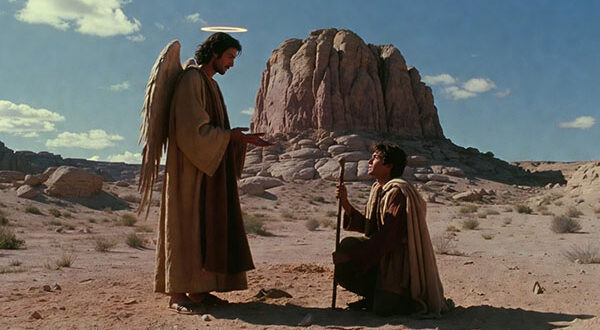
When Tobit loses his sight and falls into poverty, he sends his son Tobiah to recover money deposited in Media. It is a distant and dangerous mission. Here begins the young man’s initiatory journey, accompanied by a mysterious guide who will later reveal himself as the Archangel Raphael.
Theologically, this journey symbolizes the path of the Christian life:
- We leave the security of home.
- We face trials and dangers.
- We learn to trust.
- We discover that God never leaves us alone.
Tobiah does not rebel with defiance; he trusts. The filial obedience he shows is not passivity, but a mature form of humility. In a world that idolizes self-sufficiency, the figure of Tobiah reminds us that docility to God’s will is a source of blessing.
3. The Angel Raphael: Invisible Providence
One of the most fascinating elements of the book is the presence of the Archangel Raphael. Under human appearance, he accompanies, guides, protects, and heals.
Catholic tradition has seen in this passage a clear affirmation of the doctrine concerning guardian angels and divine providence. God often acts through invisible mediations.
In our current lives, how many times do we experience “providential coincidences”? How many right decisions have been the fruit of an inspiration that seemed simple yet decisive?
The Book of Tobit teaches us that God intervenes in the concrete history of individuals, even when we do not immediately recognize Him.
“I am Raphael, one of the seven angels who stand ready and enter before the glory of the Lord.” (Tob 12:15)
This final revelation invites us to live with supernatural awareness: our life is not limited to what is visible.
4. Sarah and Marriage: Purity, Prayer, and Spiritual Combat
One of the most profound passages in the book is the marriage between Tobiah and Sarah. She had suffered the death of seven husbands because of the demon Asmodeus. Here a key element is introduced: spiritual combat surrounding marriage.
The devil hates the union blessed by God because marriage is an image of the faithful and fruitful love of the Creator.
Before consummating the marriage, Tobiah and Sarah pray together. This gesture is revolutionary and deeply relevant today.
“And now, O Lord, you know that I take this wife of mine not because of lust, but with sincerity.” (Tob 8:7)
This prayer reveals the Catholic theology of marriage:
- It is not a mere social contract.
- It is not just emotion.
- It is a sacred vocation.
- It has a spiritual dimension and a mission.
In a culture that trivializes commitment, Tobiah reminds us that chastity, conjugal prayer, and right intention are the foundation of lasting happiness.
5. The Theology of Trial: Suffering as Purification
Tobit loses his sight. Sarah suffers humiliation. Tobiah faces dangers. Nothing is easy in this story.
Yet here we find a central teaching of Catholic spirituality: God permits trials in order to purify, not to destroy.
Suffering, lived in faith, becomes an instrument of sanctification.
Tobit prays in his affliction:
“You are righteous, O Lord, and all your deeds are just.” (Tob 3:2)
This attitude of trusting surrender is profoundly countercultural. Today, in the face of pain, the usual reaction is despair or rebellion. Tobiah teaches us the path of offering and hope.
6. Practical Applications for Today’s Life
The story of Tobiah is not merely an edifying narrative; it is a concrete guide for daily life.
1. Practice Almsgiving and Concrete Charity
Faith without works is sterile. Tobit risks his life to bury the dead. How do we live mercy today?
- Helping those in need.
- Accompanying the sick.
- Defending human dignity.
2. Build Marriages Centered on God
Prayer as a couple is not optional; it is vital. The home must be a “domestic church.”
3. Trust in Providence
When we do not understand what is happening, remember that the angel walks with us.
4. Honor One’s Parents
Tobiah is an example of filial respect. In an individualistic society, the family once again becomes the first school of holiness.
5. Live with Right Intention
Examine the heart. Ask ourselves: Do I do this out of vanity or out of love for God?
7. Relevance for the Christian of the 21st Century
The figure of Tobiah especially challenges young people. In the midst of a digital culture, fragile relationships, and uncertain projects, his story teaches:
- The importance of choosing one’s life partner well.
- The need for spiritual guidance.
- The value of purity.
- The power of prayer before major decisions.
It also challenges families: the transmission of faith begins at home. Tobit educated his son with coherence. Words are not enough; witness is necessary.
8. An Integral Spirituality: Prayer, Almsgiving, and Fasting
The Book of Tobit presents a classic balance of biblical spirituality:
- Constant prayer.
- Generous almsgiving.
- Upright moral life.
It is the same axis that Christ will reaffirm in the Gospel. This is not empty devotionalism, but a faith that transforms conduct.
Conclusion: A Sure Path Toward Everyday Holiness
Tobiah was neither prophet nor king. He performed no spectacular miracles. He was an obedient son, a faithful husband, a trusting man.
And precisely there lies his greatness.
In a world that idolizes the extraordinary, the Book of Tobit reminds us that holiness is built in daily fidelity: in respect for parents, in purity of love, in discreet generosity, in silent trust in God.
The story ends with healing, blessing, and joy. Yet the true miracle is not Tobit’s recovered sight, but the interior transformation of those who learned to trust.
Today, each of us is undertaking our own journey to Media. And though we may not see him, Raphael walks at our side.
May Tobiah’s prayer be ours as well: to act always with right intention, to love with purity, and to trust—even in darkness—that God writes our story with eternal wisdom.