Related Articles

There are texts that enlighten. There are texts that correct. And there are texts that shake history itself.
The Letter to the Romans belongs to the latter category.
It is the most profound, systematic, and theologically dense writing of Saint Paul. It is not simply another letter of the New Testament. It is the great treatise on grace, sin, justification, and salvation. It is the doctrinal heart of Christianity.
And what is most striking is that it was not written for academic theologians, but for a concrete, real, fragile, and divided community: the Church in Rome.
Today, in a world confused about truth, morality, and the meaning of life, the Letter to the Romans is more relevant than ever.
1. The Historical Context: Rome, Center of the World… and of Early Christianity
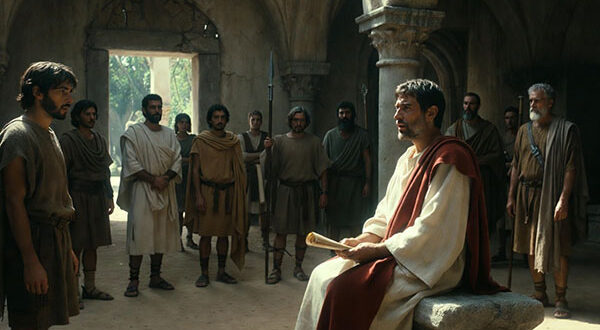
When Paul writes to the Christians in Rome (around A.D. 57–58), he has not yet visited the city. Rome is the political and cultural center of the Empire. Peoples, religions, philosophies, and power converge there.
The Roman Christian community was composed of:
- Converted Jews.
- Converted pagans.
- People with very different mentalities.
- Internal tensions regarding the Mosaic Law and customs.
Paul writes in order to:
- Prepare for his future visit.
- Doctrinally unify the community.
- Clearly expound the Gospel he preaches.
- Defend the universality of salvation.
He does not write impulsively. This is his most mature work, his theological synthesis.
2. The Central Problem: Universal Sin
Paul begins with a radical affirmation: everyone needs salvation.
“There is none righteous, not even one” (Romans 3:10).
For Paul, the human drama is not primarily political or economic. It is spiritual. It is sin.
Since Adam, humanity has been wounded. This is not merely about isolated actions, but about a condition: an interior inclination toward disorder.
What does this mean today?
We live in a culture that denies sin or redefines it as a “psychological error” or “social conditioning.” But Paul reminds us:
- Evil is not only external.
- Evil runs through the human heart.
- We need redemption, not merely education.
This truth is not pessimistic. It is liberating. Because if we acknowledge the wound, we can accept the medicine.
3. Justification: The Heart of the Gospel
Here we enter the core of Romans.
“The righteous shall live by faith” (Romans 1:17).
Justification is not simply “being forgiven.” It is being made righteous by the grace of God.
Paul teaches that:
- We are not saved by our works.
- We do not accumulate human merits to purchase heaven.
- Salvation is a gratuitous gift.
But beware: faith is not a vague idea or a religious emotion. It is total adherence to Jesus Christ.
It is obedient trust.
From the traditional Catholic theological perspective, justification is not merely an external declaration, but an interior transformation. Grace truly changes us. It does not merely “consider” us righteous; it makes us righteous.
4. Christ, the New Adam: The Restoration of Humanity
Paul establishes a profound parallel:
- Through one man (Adam), sin entered.
- Through one man (Christ), grace came.
Christ is the New Adam. Where the first disobeyed, the second obeyed unto death on the Cross.
This teaching is essential for understanding:
- The mystery of the Incarnation.
- The redemptive value of suffering.
- The centrality of the sacrifice of the Cross.
Salvation is not a theory. It is a historical event.
5. Life in the Spirit: True Freedom
Romans 8 is one of the most sublime chapters in all of Scripture.
“There is therefore now no condemnation for those who are in Christ Jesus” (Romans 8:1).
Here Paul explains life in the Spirit.
We are not called merely to avoid sin. We are called to live as sons and daughters:
- Adopted children.
- Heirs with Christ.
- Guided by the Holy Spirit.
In a world that identifies freedom with “doing whatever I want,” Paul redefines freedom:
True freedom is the ability to do good.
Slavery is not obedience to God. Slavery is being dominated by passions.
6. The Interior Struggle: Astonishing Pastoral Realism
One of Paul’s most human passages is found in Romans 7:
“For I do not do the good I want, but the evil I do not want is what I do.”
Who cannot relate?
- I want to pray… but I get distracted.
- I want to be patient… but I explode.
- I want to forgive… but I hold on to resentment.
Paul does not idealize the Christian life. He acknowledges the interior battle.
But he does not end in drama. He ends in grace.
The solution is not isolated willpower. It is dependence on Christ.
7. Israel, Election, and the Mystery of Divine Fidelity
In chapters 9–11, Paul addresses a delicate question: what about Israel if many have not accepted Christ?
Here he reveals something essential for our faith:
- God does not break His promises.
- Salvation history is organic.
- The Church does not replace, but fulfills.
From a profound theological perspective, these chapters reveal divine sovereignty and the mystery of the universal salvific plan.
8. Christian Morality: Faith Becomes Life
The second part of Romans is eminently practical.
“Do not be conformed to this world, but be transformed by the renewal of your mind” (Romans 12:2).
Paul translates theology into concrete life:
- Love without hypocrisy.
- Bless those who persecute you.
- Overcome evil with good.
- Respect legitimate authority.
- Live fraternal charity.
There is no separation between doctrine and morality. True faith transforms habits, relationships, economics, politics, sexuality, and family life.
9. Practical Applications for Today
How can Romans be applied in 2026?
1. Recognize the Need for Grace
Stop relying solely on our own strength. Return to the sacrament of confession.
2. Rediscover the Centrality of Christ
Not a generic spirituality, but a living relationship with Jesus Christ.
3. Live According to the Spirit
Practice:
- Daily prayer.
- Examination of conscience.
- Concrete mortification.
- Works of mercy.
4. Renew the Mind
Solid doctrinal formation. Study of the Catechism. Meditative reading of Romans.
5. Love in the Midst of Cultural Persecution
The Christian does not respond with aggression, but with firmness and charity.
10. Romans and the Modern World
We live in times of:
- Moral relativism.
- Anthropological confusion.
- Radical individualism.
- Crisis of identity.
Romans offers clarity:
- Objective truth exists.
- Man needs redemption.
- Grace is real.
- Christ is the only Savior.
It is not a comfortable message. It is a true one.
Conclusion: Are You Willing to Be Transformed?
The Letter to the Romans is not merely a text to study. It is an invitation to an interior revolution.
Paul does not write to entertain. He writes to save.
If today you take this letter and read it slowly, chapter by chapter, you can experience what millions have experienced throughout history:
- Conversion.
- Clarity.
- Strength.
- Hope.
Because the central message remains the same:
“Where sin increased, grace abounded all the more” (Romans 5:20).
And that grace is available today.
Not for a spiritual elite.
Not for an idealized past.
But for you.
The Letter to the Romans does not belong to the first century.
It belongs to every heart that needs redemption.
And that heart… is ours.