
Related Articles



For centuries, Christians looked at the night sky not only with wonder, but with certainty: beyond the stars, beyond the visible heavens, lay the Empyrean Heaven, the dwelling place of God and the blessed.
Today, in an age dominated by space telescopes and cosmological theories, this idea may seem poetic or even naïve. Yet the Empyrean Heaven is not merely a medieval curiosity. It is a doorway into understanding how the Church has reflected on the relationship between God, the universe, and our eternal destiny.
Let us discover together what the Empyrean Heaven is, how this conception was born, and what it can teach us today for our spiritual life.
🌌 1. What Does “Empyrean Heaven” Mean?
The word “empyrean” comes from the Greek empyros, meaning “fiery” or “full of fire.” This is not a material fire, but the fire of divine glory, the pure light that proceeds from God.
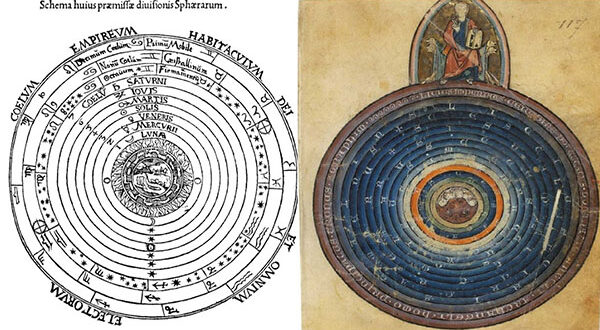
In medieval cosmology, the universe was structured in concentric spheres:
- The Earth at the center.
- The spheres of the planets.
- The sphere of the fixed stars.
- The “Prime Mover.”
- And finally, beyond all visible creation: the Empyrean Heaven.
There dwelt God with the angels and the saints. It was the highest realm—immobile, perfect, and eternal.
This vision was developed by great Christian thinkers such as Santo Tomás de Aquino, who integrated Aristotelian cosmology into Christian theology, and it reached its most sublime literary expression in the work of Dante Alighieri.
📖 2. Biblical Foundation: Does the Bible Speak of a “Physical” Heaven?
Sacred Scripture uses a deeply symbolic and pedagogical language. In the Old Testament we read:
“The Lord has established His throne in heaven” (Psalm 103:19).
And Saint Paul writes:
“I know a man in Christ… who was caught up to the third heaven” (2 Corinthians 12:2).
In ancient Jewish thought, several “heavens” were spoken of, culminating in the highest, where God manifests His glory. This is not an astronomical description, but a way of expressing transcendence and supremacy.
When medieval thinkers placed the Empyrean Heaven “above the stars,” they were not attempting to do modern science. They were affirming something essential:
God is beyond all created reality.
🌠 3. Medieval Cosmology and the Hierarchical Universe
In the Middle Ages, following Aristotle and Ptolemy, the universe was conceived as an ordered and hierarchical cosmos. It was neither infinite nor chaotic, but harmonious and meaningful.
The Earth occupied the center—not as an honor, but because of density and corruption. What was higher was more perfect. Thus, the Empyrean Heaven, at the summit of the cosmos, symbolized:
- Absolute perfection.
- Divine immobility.
- The fullness of eternal love.
For Saint Thomas Aquinas, the Empyrean Heaven was not merely a metaphor: he understood it as a special created reality, beyond movement and time, where the blessed dwell.
✨ 4. The Empyrean Heaven in the Divine Comedy
In the Paradiso of the Divine Comedy, Dante describes the Empyrean as an ocean of pure light, where the saints form a “celestial rose” and where he ultimately beholds God as the “love that moves the sun and the other stars.”
Here we grasp something profound:
The Empyrean Heaven is not simply a “place.” It is perfect communion with God.
🔭 5. What Happened When Astronomy Changed?
With Nicolás Copérnico, and later with Galileo Galilei, the geocentric model was replaced by the heliocentric one. The universe ceased to be understood as a series of finite spheres and came to be conceived as vast and even potentially infinite.
Did the Empyrean Heaven disappear?
No. What disappeared was the literal cosmological image.
But the theological truth remains intact:
- God is not contained within space.
- Heaven is not an astronomical point.
- Eternal glory transcends physical coordinates.
The Catechism teaches that heaven is “the state of supreme and definitive happiness” in communion with God.
🔥 6. The Profound Theological Meaning
From a theological point of view, the Empyrean Heaven expresses three fundamental truths:
1️⃣ God is transcendent
He is not part of the universe. He is not within it as just another object.
2️⃣ Creation is ordered toward Him
The entire cosmos points toward its Creator.
3️⃣ Our destiny is supernatural
We are not made only for this world.
As Saint Paul says:
“Our citizenship is in heaven” (Philippians 3:20).
🌍 7. What Does the Empyrean Heaven Tell Us Today?
In a materialistic culture, where only what is measurable seems real, the concept of the Empyrean Heaven reminds us that:
- Reality is not exhausted by what is visible.
- The human person has an eternal destiny.
- History has direction.
Today we can send probes to the edges of the solar system, but no telescope will find heaven as a state of grace. Because heaven is not a distant galaxy: it is the very life of God shared with us.
🕊 8. Practical Applications for Daily Life
Here is where the Empyrean Heaven ceases to be theory and becomes pastoral reality.
✨ 1. Live with an Eternal Perspective
If heaven is our goal, our decisions change.
- Do I forgive or hold resentment?
- Do I seek holiness or comfort?
- Do I live only for today or for eternity?
✨ 2. Order the Heart
Medieval cosmology taught an ordered universe.
Our soul also needs order.
When God occupies the center, everything finds its proper place.
✨ 3. Lift Your Gaze
The Christian is someone who looks beyond.
Amid crises, wars, and uncertainty, we remember that our hope does not rest in human structures but in the eternal promise.
🌟 9. From “Physical Above” to “Spiritual Beyond”
The great lesson is this:
The Empyrean Heaven was not a naïve error. It was a pedagogy.
Medieval thinkers used the language of the cosmos to express an eternal truth:
God is above all things, and toward Him we journey.
Today we no longer imagine crystalline spheres revolving around the Earth. But we still profess:
- I believe in eternal life.
- I believe in the resurrection of the body.
- I believe in the communion of saints.
Heaven is not “above” in an astronomical sense.
It is “beyond” in an ontological sense.
💡 Conclusion: Recovering the Sense of Transcendence
Perhaps the greatest danger of our time is not denying heaven, but forgetting it.
The Empyrean Heaven invites us to recover:
- A sense of wonder.
- Awareness of our eternal dignity.
- Orientation toward what is above.
Because in the end, the question is not where heaven is.
The question is: Where is your heart oriented?
As the Psalm says:
“I lift up my eyes to the hills—
from where does my help come?
My help comes from the Lord” (Psalm 121:1–2).
May our entire life be an interior ascent toward that true Empyrean, where Love does not fade and light has no sunset.
And may every daily decision be one more step toward that homeland discovered not with telescopes, but with holiness.