
Related Articles



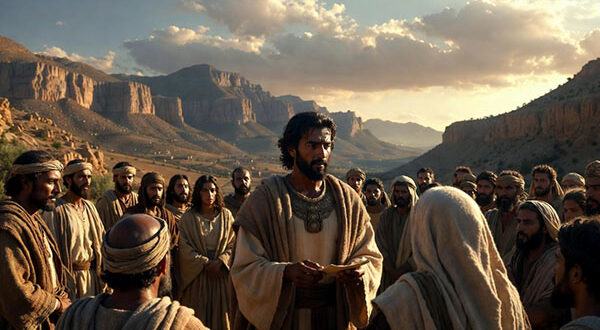
There are books of the Bible that recount events. Others proclaim prophecies. But Deuteronomy is something different: it is a heart that beats. It is the voice of a father who, before dying, gathers his children and reminds them who they are, where they come from, and where they must go.
The Book of Deuteronomy is not simply a code of ancient laws. It is the spiritual testament of Moses. It is the book that Jesus quoted in the desert. It is the burning synthesis of the Covenant between God and His people. And although it was written more than three thousand years ago, it speaks with astonishing clarity to the man of the twenty-first century.
If we know how to listen to it, it can change our lives.
1. What Is Deuteronomy and Why Is It So Important?
The name “Deuteronomy” literally means “second law” (from the Greek deutero-nomos). But it is not a different law; rather, it is a renewal of the Law already given at Sinai.
It forms part of the Pentateuch—together with Genesis, Exodus, Leviticus, and Numbers—and it gathers the final speeches of Moses before the people of Israel enter the Promised Land. Moses knows he will not cross the Jordan. And so he speaks with urgency, tenderness, and firmness.
It is not a cold treatise. It is a passionate reminder:
“Hear, O Israel: The Lord our God is one Lord. And you shall love the Lord your God with all your heart, and with all your soul, and with all your might” (Deut 6:4–5).
This passage, known as the Shema, is the core of Judaism and was quoted by Christ as the first commandment (cf. Mt 22:37). It is no coincidence. Deuteronomy contains the essence of biblical spirituality.
2. Historical Context: A People on the Edge of Their Destiny
Israel has come out of Egypt. It has received the Law at Sinai. It has wandered forty years through the desert being purified. Now it stands before the Promised Land.
But there is a problem: the generation that left Egypt has died. The new generation did not live through Sinai. They did not see the Red Sea open.
And Moses knows it: if they do not remember, they will forget. If they forget, they will betray. If they betray, they will lose the blessing.
That is why Deuteronomy is, above all, a book of memory. A passionate catechesis about fidelity.
In a world like ours—one that lives for the instant, for constant novelty, and for the systematic forgetting of the past—this book is more necessary than ever.
3. The Theology of Deuteronomy: Covenant, Love, and Freedom
a) God Chooses Out of Love
Deuteronomy insists on something revolutionary: Israel was not chosen because it was strong, numerous, or powerful.
“It was not because you were more in number than any other people that the Lord set His love upon you and chose you… but because the Lord loves you” (Deut 7:7–8).
Here we find a fundamental theological key: divine election is gratuitous.
God does not love us because we are good. We are called to be good because God loves us.
In a time when a person’s worth is measured by productivity, success, or image, Deuteronomy proclaims a liberating truth: your dignity does not depend on your performance. It depends on God’s love.
b) The Law Is Not Oppression, but the Path to Life
Today the word “law” sounds like restriction. But in Deuteronomy the Law is presented as wisdom and life.
“See, I have set before you this day life and good, death and evil… therefore choose life” (Deut 30:15,19).
The Law is not an arbitrary burden. It is a map so that we do not get lost.
From a traditional theological perspective, the Law of the Old Testament prepares the heart for Christ. It is not abolished, but fulfilled in Him. As the Church teaches, the Old Law is divine pedagogy.
Pastorally, this is crucial: Christian morality is not a collection of prohibitions, but an invitation to choose true life.
c) Total and Concrete Love
Deuteronomy does not ask for sentimental love. It asks for total love:
- With all the heart (interiority).
- With all the soul (self-giving).
- With all the strength (concrete action).
Faith cannot remain at the level of ideas. It must permeate family life, economic life, political life, and social life.
In chapter 6, the people are commanded to teach the Law to their children, to speak of it at home, to write it on their doorposts. It is a faith that shapes culture.
Is this not urgent today, when faith has been relegated to the private sphere?
4. Deuteronomy in the Life of Jesus
When Jesucristo is tempted in the desert (Mt 4), He answers Satan by quoting Deuteronomy.
He does not quote the Psalms. He does not quote Isaiah. He quotes Deuteronomy.
“Man shall not live by bread alone” (Deut 8:3).
“You shall not tempt the Lord your God” (Deut 6:16).
“You shall worship the Lord your God” (Deut 6:13).
This reveals something profound: Deuteronomy is a manual for spiritual combat.
Christ, the new Israel, conquers where the old people fell. And He does so by relying on this Word.
If Jesus used it to resist temptation, how could we not need it?
5. Practical Applications for Today
1. Recover Spiritual Memory
Remember your history with God. From what has He brought you out? What deserts have you crossed?
Deuteronomy insists: do not forget. Forgetfulness is the prelude to apostasy.
A concrete practice: write in a notebook the moments when you have seen God’s providence.
2. Live the Faith in the Family
The book insists on passing the faith on to children.
In a context where secularization advances, the family once again becomes the first seminary, the first school of faith.
Pray with your children. Bless the table. Speak about God naturally. Do not completely delegate to the parish what is the primary mission of the home.
3. Choose Life Every Day
“Choose life.”
Every moral decision is a choice between life and spiritual death.
In a relativistic culture, Deuteronomy reminds us that our decisions have real consequences.
4. Fight Modern Idolatry
Deuteronomy constantly warns against idols.
Today we do not worship statues of Baal. But we do worship:
- Money
- Power
- Ideology
- The cult of the self
Idolatry is placing something in the position that belongs to God alone.
A concrete pastoral examination: what occupies my thoughts? What do I fear losing more than God?
6. A Prophetic Book for Our Time
We live in an era of moral crisis, doctrinal confusion, and weakening Christian identity.
Deuteronomy speaks to a people about to enter a land full of pagan cultures. Is that not also our situation?
Moses warns: you will prosper, you will have goods, and then you will forget God.
Is that not the portrait of the West?
The answer is not fear, but fidelity. Deuteronomy is not a pessimistic book. It is a call to continual conversion.
7. Final Pastoral Key: The Obedience That Liberates
The word obedience today generates rejection. But in its Latin root (ob-audire) it means “to listen deeply.”
Deuteronomy begins with one word: “Hear.”
Listening to God is the most revolutionary act we can perform in a world saturated with noise.
It is not about moralism. It is about communion.
Conclusion: Deuteronomy Is Not the Past—It Is Urgency
Deuteronomy is not an archaeological book. It is a voice that cries out today:
- Remember.
- Love.
- Obey.
- Choose life.
It is the echo of Moses’ heart. And it is, ultimately, the echo of God’s heart.
If you read it attentively, you will discover that it is not a collection of ancient norms, but an invitation to live with radicality and coherence in the midst of a world that has forgotten what is essential.
Perhaps the final question this book leaves us with is the same one Moses posed to the people:
Whom will you serve?
Because every day, consciously or unconsciously, we choose.
And eternal life begins in that choice.