Related Articles
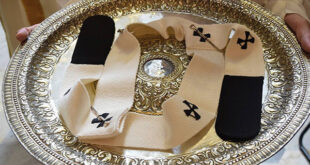
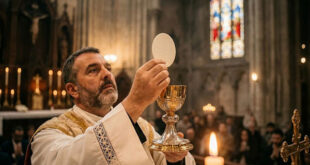

There is one day each year when something happens that, at first glance, seems impossible: no priest anywhere in the world may consecrate the Eucharist.
On a planet where thousands of Masses are celebrated every single day—from great cathedrals to the humblest chapels—there is a moment when the unbloody Sacrifice of Calvary is not made present sacramentally. The altar remains stripped. The tabernacle is empty. No bells ring. There are no words of consecration.
That day is Good Friday.
And what takes place on it is profoundly theological, radically countercultural, and spiritually transformative.
The Mystery of Good Friday
Good Friday of the Passion of the Lord is the only day of the year in the Latin Church when the Holy Mass is not celebrated. Instead, the Church celebrates the Celebration of the Passion of the Lord, a solemn, austere, and deeply moving liturgical action.
In it:
- There is no offertory.
- There is no Eucharistic Prayer.
- There is no consecration.
The Communion distributed that day comes from hosts consecrated the previous day, on Holy Thursday, during the Mass In Coena Domini.
Why?
Because on Good Friday the Church does not celebrate the Sacrifice in a sacramental manner: she contemplates it in its historical reality. That day we do not “make Calvary present” sacramentally; that day we accompany it.
What Is the “Mass of the Presanctified”?
Historically, this celebration was called the “Mass of the Presanctified”, because the faithful received gifts previously sanctified (prae-sanctificata). Strictly speaking, it was not a Mass, since the consecration was absent, but it preserved certain external elements that made it resemble one.
In the Byzantine tradition there still exists the Liturgy of the Presanctified Gifts, especially during Lent, reminding us that this practice reaches back to the earliest centuries of Christianity.
From very early on, the Church understood that Good Friday is not just any day: it is the day when the Bridegroom is taken away (cf. Mt 9:15). It is a day of fasting, of silence, of absence.
And the liturgy expresses that absence through visible signs.
Theological Foundation: The Silence of the Sacrifice
The Mass is the Sacrifice of Christ made present sacramentally. But on Good Friday we do not celebrate the Sacrifice as a sacramental sign, because that day the Church spiritually places herself at the foot of the Cross.
“It is finished.” (Jn 19:30)
The Church does not multiply the sacramental sign when the very event itself is contemplated in its historical starkness. It is a day when liturgical time folds itself over real time—the time of the Passion.
Theologically, this is immensely profound:
- The Church affirms that the Eucharist is the very same Sacrifice of Calvary.
- She also affirms that Calvary occurred once and for all.
- Good Friday places us before the unrepeatable uniqueness of that redemptive act.
There is no consecration because that day we do not “make present” sacramentally what we are living liturgically as an event.
It is divine pedagogy.
The Stripped Altar: A Visual Catechesis
The altar is without cloths.
The tabernacle is empty.
The images are veiled.
The bells are silent.
The Church teaches through the senses.
In a society saturated with noise, consumption, and constant stimulation, Good Friday is a spiritual provocation. It forces us to confront emptiness.
But it is not a nihilistic emptiness.
It is the emptiness of the tomb.
It is the silence before the Resurrection.
Christological Dimension: The Bridegroom Taken Away
Jesus Himself foretold it:
“Can the wedding guests mourn as long as the bridegroom is with them? The days will come when the bridegroom is taken away from them, and then they will fast.” (Mt 9:15)
Good Friday is the day when the Bridegroom is taken away.
The Church lives liturgically that absence. She does not celebrate the Banquet because the Bridegroom is giving His life. The Lamb is being immolated.
Here we find a central theological truth: the liturgy is not religious theater; it is real participation in the Mystery.
Ecclesiological Dimension: The Church as Bride
The fact that no priest may consecrate on that day is profoundly meaningful.
The whole Church submits herself to the logic of the Paschal Mystery. The priest, who acts in persona Christi, does not exercise that day the sacramental power to consecrate because the Church wishes to emphasize that all priesthood derives from the one Sacrifice of Christ.
It is an act of liturgical humility.
It is as if the Church were saying:
“Today we do not speak. Today we listen. Today we contemplate.”
Pastoral Application: What Does This Mean for Us Today?
Here lies the essential point.
In a world that demands immediate solutions, quick answers, and instant consolations, Good Friday teaches us the value of silence, of offered suffering, and of confident waiting.
1. Learning to Remain
The disciples fled. Mary remained.
Good Friday teaches us not to flee from suffering. To remain beside the cross of our children, our marriage, our illness, our professional uncertainty.
Not every suffering must be solved immediately.
Some must be contemplated and offered.
2. Rediscovering the Value of Fasting
The absence of Mass is the greatest liturgical fast of the year.
What if we learned to fast also from digital noise?
From constant complaining?
From impulsive consumption?
Fasting creates space for God.
3. Understanding the Price of Our Redemption
When consecration is absent, we understand how much we need it.
Many Catholics experience Mass as something automatic. Good Friday reminds us that the Eucharist is an immense gift, born from the opened side of Christ.
Nothing is owed to us.
Everything has been given.
Contemporary Relevance: A Church That Knows How to Be Silent
We live in turbulent times: crises of faith, secularization, cultural persecution, doctrinal confusion.
Good Friday teaches that the Church does not triumph through noise or marketing strategies, but through fidelity to the Mystery of the Cross.
The modern world fears suffering.
The Church redeems it.
The world seeks to eliminate the cross.
The Church adores it.
During the Celebration of the Passion on Good Friday, the Church sings:
“Behold the wood of the Cross, on which hung the salvation of the world.”
And the people respond:
“Come, let us adore.”
The Great Silence That Saves
The absence of consecration is not poverty.
It is contemplative fullness.
That day, the universal Church falls silent before the greatest mystery in history: the Son of God dead out of love.
And in that silence we learn:
- That God does not always act as we expect.
- That apparent defeat can be victory.
- That true love passes through self-giving.
Conclusion: Living Good Friday Every Day
We cannot live permanently in Good Friday.
But neither can we live only in Easter Sunday.
The Christian life is paschal:
cross and glory,
death and life,
silence and song.
Each time we accept a difficulty out of love,
each time we offer suffering,
each time we remain faithful without sensible consolation,
we are living something of the spirit of Good Friday.
And then we understand that the day when no priest may consecrate is not a day of God’s absence.
It is the day when God gives everything.
For from that silence bursts forth the greatest hope in history:
the Resurrection.
And that hope changes everything.