
Related Articles

Many Christians—and many non-believers as well—have asked themselves this question at some point:
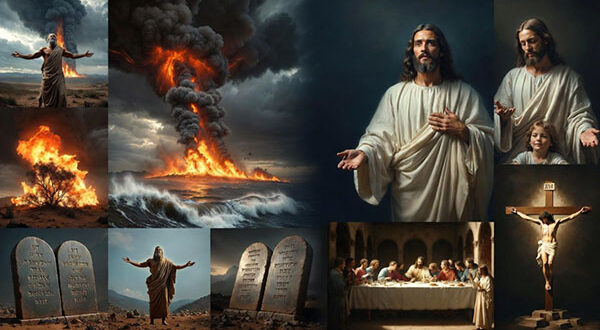
How can it be the same God who orders wars in the Old Testament and who preaches love of enemies in the New?
In a culture like ours, marked by sensitivity toward peace, social justice, and mercy, the contrast seems even more shocking. People speak of the “severe and punishing God” of the Old Testament versus the “kind and understanding God” revealed by Jesus Christ.
But is this really the case?
Are there two different gods?
Did God evolve?
Did He become kinder over time?
The Catholic answer is clear, firm, and profoundly beautiful:
God is one, eternal, and immutable. He does not change. What changes is our capacity to understand Him.
And understanding this is not merely an intellectual matter. It is a spiritual matter that transforms our lives.
1. An Ancient Error: The Heresy of Marcion
The idea that the God of the Old Testament is different from the God of the New is not new. In the second century, a heretic named Marcion claimed that the God of the Old Testament was an inferior, harsh, and legalistic deity, while the Father of Jesus was a different god—good and merciful.
The Church firmly rejected this position. Why?
Because it breaks the unity of Revelation and destroys the heart of Christianity: Jesus Christ is the fulfillment of the Old Testament, not its negation.
Jesus Himself affirmed this:
“Do not think that I have come to abolish the Law or the Prophets; I have not come to abolish them but to fulfill them.” (Matthew 5:17)
Christ does not correct God. Christ fully reveals who God is.
2. The Old Testament: Justice, Pedagogy, and Covenant
To understand the Old Testament, we must situate ourselves in its historical and spiritual context.
Israel lived surrounded by violent, idolatrous, and morally degraded pagan cultures. God did not choose Israel because it was perfect, but to educate it, purify it, and prepare it for something infinitely greater: the Incarnation.
Divine Pedagogy
God acts as a teacher. He educates progressively.
Saint Irenaeus spoke of the divine “economy”: God adapts Himself to man’s capacity, like a father who teaches step by step.
In the Old Testament we find strict justice, severe laws, exemplary punishments. Why?
Because the people were still at an early stage of moral understanding. It was necessary to establish:
- The gravity of sin
- The absolute holiness of God
- The necessity of obedience
- The seriousness of the covenant
Yet even in the Old Testament we find abundant mercy:
“The Lord is compassionate and gracious, slow to anger, abounding in love.” (Psalm 103:8)
That verse is not in the New Testament. It is in the Old.
God did not change. Mercy was already there.
3. What About the Punishments and the Wars?
Here arises the strongest objection: Israel’s wars, divine punishments, the flood, Sodom and Gomorrah.
To understand this theologically, we must consider three elements:
1. God Is Just
Mercy does not cancel justice.
Sin has real consequences.
In our modern culture we tend to minimize sin. But in the Bible, sin is not merely a moral mistake: it is a radical rupture with Life itself.
If God punished evil, He would be unjust? No.
If He did not punish it, He would be indifferent.
Divine judgment reveals that evil matters.
2. Biblical Language
Many accounts use symbolic, epic, and culturally conditioned language. They are not modern chronicles. They express theological truths in literary forms proper to their time.
The Church has never read these texts in a fundamentalist way.
3. God Acts in History to Save
Even punishments have a medicinal purpose. They are corrections.
As the Letter to the Hebrews says:
“The Lord disciplines the one He loves.” (Hebrews 12:6)
Punishment is not irrational revenge. It is justice ordered toward the good.
4. The New Testament: Only Mercy?
Many believe that judgment disappears in the New Testament. But this is not so.
Jesus speaks about hell more than anyone else in the Bible.
He speaks of “weeping and gnashing of teeth.”
He speaks of eternal separation.
Christ expels the merchants from the Temple.
He condemns Pharisaic hypocrisy with very harsh words.
So where is the difference?
The difference is not that God changes.
The difference is that now we see His face.
5. In Christ, Justice and Mercy Are United
The key is the Cross.
On the Cross something extraordinary happens:
- Justice is fulfilled: sin has real consequence.
- Mercy triumphs: God Himself assumes that consequence.
God does not ignore evil.
He takes it upon Himself.
This changes everything.
The Old Testament showed the gravity of sin.
The New Testament shows the price of forgiveness.
Saint Paul expresses it profoundly:
“Where sin increased, grace abounded all the more.” (Romans 5:20)
There is no opposition between justice and mercy.
There is fulfillment.
6. Why It Is Hard for Us to Understand Today
We live in a culture that:
- Rejects the idea of judgment
- Confuses love with permissiveness
- Reduces sin to a psychological error
We want a God who consoles, but not one who corrects.
However, a God who does not judge evil is not loving.
He would be indifferent to the suffering of victims.
Divine justice guarantees that evil does not have the last word.
7. Practical Applications for Our Lives
This topic is not merely theological. It is profoundly pastoral.
1. Recovering the Sense of Sin
If God is merciful, it is because sin is real.
Serious examination of conscience.
Frequent confession.
Sacramental life.
Without awareness of evil, mercy loses its meaning.
2. Understanding Correction in Our Lives
When we go through trials, let us not think God has abandoned us.
Sometimes God allows purifications.
Not to destroy us, but to sanctify us.
The Old Testament reminds us that God takes our conversion seriously.
3. Living in Balance: Neither Rigorism Nor Laxity
Some Christians remain anchored in a “punishing God.”
Others speak only of a “God who permits everything.”
The Catholic faith maintains the balance:
- God is infinitely holy.
- God is infinitely merciful.
- Both at the same time.
8. The Deep Unity of Revelation
The Old Testament is promise.
The New Testament is fulfillment.
Saint Augustine expressed it masterfully:
“The New Testament is hidden in the Old, and the Old is made manifest in the New.”
There is no rupture.
There is development.
Like a seed that becomes a tree.
9. A Spiritual Guide for Today
If today you feel that God is harsh with you, remember:
His justice is not cruelty.
It is love that purifies.
If today you feel that God is too demanding, remember:
Christ died for you.
If today you fear judgment, remember:
Mercy is open while there is life.
But do not confuse mercy with indifference.
10. The Right Image of God Transforms Your Life
The image we have of God shapes everything:
- How we pray
- How we confess
- How we educate our children
- How we understand suffering
If we see God only as judge, we will live in fear.
If we see Him only as a permissive friend, we will live in superficiality.
But if we understand that He is a just and merciful Father, we will live in reverent trust.
Conclusion: Not Two Gods. The Same Love Revealed Progressively.
The God of the Old Testament is not a vengeful deity.
He is the holy God who prepares His people.
The God of the New Testament is not a soft god.
He is the same God who reveals His heart in Christ.
On the Cross we understand everything:
Justice does not disappear.
Mercy does not deny truth.
Love does not eliminate holiness.
God did not change.
What changed was the fullness of revelation.
And today, in a world oscillating between relativism and fear, we need to rediscover this truth:
God is fire that purifies and embrace that saves.
And that God—the same God of Abraham, of Moses, and of Jesus—continues to act in your history.
He is not different.
He is deeper than we ever imagined.