Related Articles


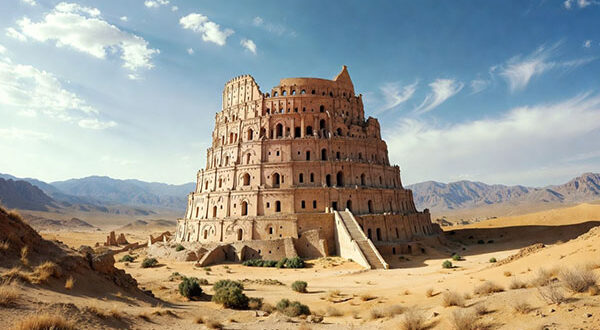
At the heart of the Book of Genesis we find one of the briefest and, at the same time, most profound accounts in all Sacred Scripture: the Tower of Babel. Far from being merely a story about confused languages or a myth explaining cultural diversity, this episode reveals an immensely relevant spiritual teaching about human pride, false unity, ambition without God, and the need to return to the divine order.
In a globalized world that seeks unity without truth, progress without limits, and power without transcendence, the account of Babel resonates today with astonishing force. This passage speaks about us, our societies, and our relationship with God.
This article aims to help you understand its history, its theological meaning, and its implications for the spiritual life of Christians today.
The Biblical Account: The Origin of Human Division
The episode appears in Genesis 11:1–9, immediately after the flood and the renewal of humanity through Noah.
Scripture says:
“Now the whole earth had one language and the same words… Then they said, ‘Come, let us build ourselves a city and a tower with its top in the heavens, and let us make a name for ourselves, lest we be scattered over the face of the whole earth.’” (Genesis 11:1, 4)
The people decide to build a city and a gigantic tower reaching the heavens. It is not merely an architectural project, but a spiritual declaration: man seeks to reach God by his own strength.
God intervenes by confusing their languages and scattering them:
“So the Lord scattered them from there over the face of all the earth, and they left off building the city.” (Genesis 11:8)
Thus Babel is born, a name associated with confusion.
But why does God act in this way? What sin is there in building a tower?
The answer leads us into a teaching of immense theological depth.
The True Sin of Babel: Pride That Excludes God
Christian tradition has interpreted the Tower of Babel as a symbol of collective pride.
The problem was not technical or cultural, but spiritual.
1. “Let us make a name for ourselves”: the self-divinization of man
The key phrase of the account is:
“Let us make a name for ourselves.”
In biblical thought, the “name” represents identity, glory, and authority. Here the human being seeks greatness independent of God.
It is the same sin of Adam and Eve:
- wanting to be like God,
- deciding good and evil for themselves,
- living without dependence on the Creator.
Babel represents civilization founded upon the human ego.
2. False unity without truth
Interestingly, in Babel there is perfect human unity:
- one language,
- one project,
- one goal.
But this unity is directed against God.
This reveals a key teaching:
👉 Not every form of unity is good if it is not oriented toward goodness and truth.
The Church teaches that true communion exists only in God. Unity without truth ends in tyranny or confusion.
3. Rebellion against the divine command
God had commanded humanity:
“Fill the earth” (Genesis 9:1).
Yet the people say:
“lest we be scattered.”
They directly oppose the divine plan. Babel thus represents human self-sufficiency in the face of God’s will.
The Tower of Babel as a Permanent Symbol of Fallen Humanity
The Church Fathers saw in Babel far more than a historical event.
Saint Augustine distinguishes two cities:
- The City of God → founded on the love of God.
- The earthly city (Babel) → founded on love of self to the contempt of God.
Babel represents every culture, system, or civilization that seeks to build the world without God.
Babel and Pentecost: God’s Remedy for Human Division
The Bible presents a fascinating contrast between Babel and Pentecost.
At Babel:
- pride divides,
- language fragments,
- humanity is scattered.
At Pentecost (Acts 2):
- the Holy Spirit descends,
- the apostles speak different languages,
- everyone understands the same message.
God does not eliminate diversity: He harmonizes it.
👉 Babel divides from below.
👉 Pentecost unites from above.
The Church is born as the true response to Babel: a universal unity founded in Christ.
The Relevance of Babel in the Modern World
This account is remarkably prophetic.
We live in an era marked by global projects seeking:
- limitless progress,
- technology without ethics,
- unity without God,
- identity based on human power.
Some evident parallels:
1. The myth of absolute progress
The contemporary mindset often believes that technical development will save humanity:
- artificial intelligence,
- biotechnology,
- social engineering,
- total control of the world.
But when progress forgets the moral and spiritual dimension, it reproduces the spirit of Babel.
2. The culture of “I create myself”
Modern man seeks to define himself without reference to God:
- identity without nature,
- morality without truth,
- freedom without limits.
It is a new way of saying: “let us make a name for ourselves.”
3. Cultural and moral confusion
The result of excluding God is confusion:
- moral relativism,
- loss of meaning,
- crisis of identity,
- social fragmentation.
As in Babel, when God disappears from the horizon, language itself ceases to have meaning.
The Spiritual Teaching for the Christian
The Tower of Babel is not only a historical warning, but a spiritual guide for our daily life.
1. The danger of spiritual pride
We too can build towers:
- relying only on our own strength,
- seeking recognition,
- living faith for prestige,
- wanting to control everything.
Humility is the path opposed to Babel.
2. Discerning our motivations
The account invites us to ask ourselves:
- Do I seek God’s glory or my own?
- Do my projects arise from pride or from service?
- Am I building my life on God or on myself?
3. Accepting dependence on God
Christian spirituality teaches that true greatness consists in surrender:
“He who humbles himself will be exalted” (Luke 14:11).
The path to heaven is not built from below through ambition, but from above through grace.
Divine Pedagogy: God Corrects in Order to Save
God’s intervention at Babel is not arbitrary punishment, but mercy.
If human pride had grown without limits, it would have destroyed humanity.
God:
- limits evil,
- restrains pride,
- leads toward humility.
Sometimes human frustrations are acts of providence.
The True Tower That Reaches Heaven
Christianity offers an image opposite to Babel:
- not a tower built by man,
- but a God who descends to man.
Christ is the true union between heaven and earth.
The Cross replaces the tower:
- not power, but sacrifice,
- not pride, but obedience,
- not self-sufficiency, but self-giving.
Conclusion: Between Babel and Pentecost
Humanity permanently lives between two paths:
- the path of Babel, based on pride,
- the path of Pentecost, based on grace.
Human history is the drama between building the world without God or allowing God to transform the world from within.
The Tower of Babel reminds us of an eternal truth:
👉 When man tries to take God’s place, he ultimately loses himself.
👉 When man opens himself to God, he finds true unity and fulfillment.
Today, as then, the decision remains personal.
Will we build our own tower, or will we allow God to build our lives?