Related Articles


Introduction: when a small gesture contains immense theology
In the traditional liturgy of the Church, nothing is accidental. Every object, every vestment, and every gesture is born from centuries of lived, reflected, and prayed faith. That is why, when someone discovers in an old engraving, a medieval miniature, or a solemn pontifical Mass an image of a bishop celebrating while wearing gloves, the reaction is usually one of surprise:
“Why is he wearing gloves? Isn’t that just decorative?”
The answer is far deeper.
Episcopal gloves—called chirothecae—are one of those almost forgotten liturgical elements which, nevertheless, speak powerfully to the heart and the conscience, especially in a time like ours, marked by the loss of the sense of the sacred.
This article seeks to educate, inspire, and serve as a spiritual guide, helping us rediscover:
- what chirothecae were,
- what they symbolized,
- why they fell out of use,
- and what they teach us today, even though they are rarely seen at the altar.
1. What are chirothecae?
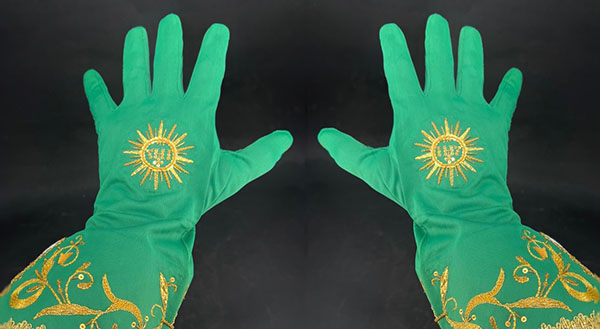
Chirothecae are liturgical gloves traditionally worn by bishops and, in certain cases, abbots with pontifical privilege, during solemn celebrations, especially at the pontifical Mass.
Main characteristics:
- They were made of silk, fine linen, or other noble fabrics.
- They were often embroidered, frequently with a cross on the back.
- Their color matched the liturgical color of the day.
- They were put on after the washing of hands and removed before the Canon of the Mass.
They were not practical accessories. They were visible theological signs.
2. A historical origin full of meaning
2.1. Medieval roots
Chirothecae are clearly documented from the 9th century, although their use became established between the 11th and 13th centuries, during the height of medieval liturgy.
In a time when:
- everything was understood symbolically,
- visual language was key for catechesis,
- and the liturgy was the heart of Christian life,
gloves were not a luxury, but a language.
2.2. Biblical and patristic influence
In Sacred Scripture, hands have enormous importance:
- with them one blesses,
- consecrates,
- anoints,
- confers authority,
- and transmits the Spirit.
“Then they laid hands on them, and they received the Holy Spirit.”
(Acts 8:17)
Covering the bishop’s hands was not meant to hide them, but to proclaim that they did not act by themselves, but as instruments of God.
3. The theological symbolism of chirothecae
Here we enter the heart of the matter.
3.1. Consecrated hands, but not “one’s own”
The bishop, successor of the Apostles, acts in persona Christi, but he is not Christ.
The chirothecae visually reminded that:
- his hands have been anointed,
- they have been set apart for the sacred,
- but they do not belong to him.
They are hands lent by God.
“It is not you who speak, but the Spirit of your Father speaking through you.”
(Matthew 10:20)
3.2. Interior and exterior purity
The gloves expressed:
- ritual purity, but above all
- moral and spiritual purity.
This was not about hygiene, but about coherence of life.
As an ancient liturgical commentary said:
“The hands that touch what is holy must be clean of sin and ambition.”
3.3. Reverent distance before the Mystery
In the biblical tradition, what is sacred is not touched without mediation.
Let us remember:
- Moses before the burning bush: “Remove the sandals from your feet” (Ex 3:5)
- The Ark of the Covenant, which could not be touched without consequences.
The chirothecae proclaimed:
God is close, but not trivial.
4. When and why did chirothecae disappear?
4.1. Liturgical simplification
From the 19th century onward, and more sharply in the 20th century:
- a more “simple” liturgy was sought,
- elements considered “ornamental” were removed,
- functionality was prioritized over symbolism.
Chirothecae came to be seen as:
- excessively ceremonial,
- difficult for the modern faithful to understand.
4.2. Change in theological sensitivity
A shift occurred:
- from mystery to human protagonism,
- from transcendence to a poorly understood closeness,
- from symbol to discourse.
The result: fewer signs… and less wonder.
4.3. They are not forbidden (an important clarification)
It is worth clarifying:
- they were never abolished or prohibited,
- they simply fell into disuse.
In extraordinary celebrations or traditional contexts, they may be legitimately used.
5. What do they teach us today, even though they are no longer used?
Here we arrive at the most pastoral and contemporary part.
5.1. For bishops and priests
Chirothecae recall a truth that is uncomfortable but necessary:
- ministry is not a possession,
- authority is service,
- the altar is not a stage.
They invite a priestly life that is:
- more interior,
- more coherent,
- more conscious of the Mystery that is touched every day.
5.2. For the lay faithful
Even if we do not wear liturgical gloves, we all have “hands”:
- hands that work,
- that write,
- that educate,
- that console,
- that can bless or wound.
The question becomes unavoidable:
What do we do with our baptized hands?
6. A practical theological and pastoral guide (very important)
6.1. Living the symbolism in daily life
1. Rediscover the value of gestures
- Make the Sign of the Cross attentively.
- Receive Holy Communion with reverence.
- Avoid mechanical routine.
2. Take care of what we “touch”
- What we look at.
- What we share.
- What we write or spread.
3. Offer our hands to God
A simple prayer:
“Lord, take my hands today.
Let them do nothing that does not glorify You.”
6.2. For parishes and catechesis
- Explain the meaning of vestments.
- Show images of traditional liturgy.
- Recover symbolic catechesis.
👉 People do not reject mystery; they reject what is not explained to them.
6.3. For personal discernment
Questions for the soul:
- Do I treat what is sacred with familiarity or with loving reverence?
- Have I trivialized what should fill me with awe?
- Do I live my faith with my body… or only with ideas?
7. A Church that needs to “cover its hands” again
Chirothecae were not an aesthetic whim.
They were a silent cry proclaiming:
God is Holy.
The altar is not common.
And our hands must learn once again to tremble before the Mystery.
Perhaps we will not see episcopal gloves at every Mass again.
But we can recover their spirit:
- greater reverence,
- deeper humility,
- stronger awareness of what we celebrate.
Because when the Church loses her signs,
she also loses the language of the soul.
And today, more than ever, we need to learn to speak it again. ✝️