Related Articles


A revolt, a cross, an eternal lesson for today’s Catholics
To speak of the Pilgrimage of Grace is not merely to recount a historical episode from the sixteenth century. It is to speak of awakened consciences, of a simple people who, faced with a direct attack on their faith, decided to walk — literally and spiritually — to defend what they held sacred. At its heart, it is a living catechesis on fidelity, obedience, the limits of power, and the cost of confessing the faith in times of confusion.
Today, when many Catholics live a diluted faith, privatized or reduced to mere sentiment, the Pilgrimage of Grace resonates with an unexpectedly contemporary force.
1. What was the Pilgrimage of Grace?
The Pilgrimage of Grace was a great popular uprising that took place in England in 1536, during the reign of Henry VIII, as a reaction to the break with Rome and the process of dissolving the monasteries.
It was not a political revolution in the usual sense. It was a religious revolt, profoundly Catholic, which brought together:
- Peasants
- Artisans
- Clergy
- Nobles faithful to Rome
All united under one banner: the defense of the Catholic faith, the Eucharist, the Church, and the Pope.
And they did so under a deeply meaningful name: Pilgrimage. They did not call themselves an “army,” nor a “party,” nor a “rebellion.” They called themselves pilgrims, because they understood their action as a spiritual, penitential, and religious act.
2. The context: when power sought to redefine the faith
To understand the Pilgrimage of Grace, one must understand the historical moment:
- Henry VIII breaks with Rome in order to divorce.
- He proclaims himself Supreme Head of the Church in England.
- The authority of the Pope is suppressed.
- Monasteries are dissolved and sacred goods confiscated.
- Those who remain faithful to traditional Catholic faith are persecuted.
For the English people, especially in the north of the country, this was not an “administrative reform.” It was a direct attack on the order willed by God.
Monasteries were not merely buildings:
- They were centers of prayer.
- They were hospitals.
- They were schools.
- They were refuges for the poor.
To close monasteries was to tear out the spiritual and social heart of the people.
3. A revolt with rosaries, not ideologies
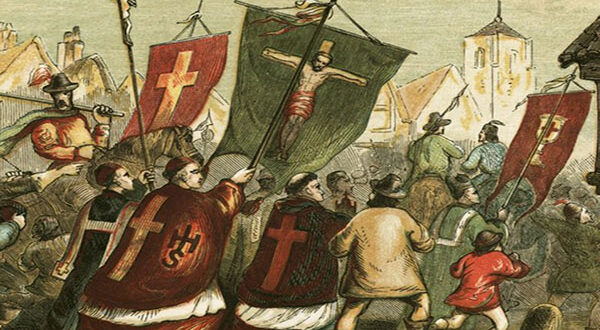
The pilgrims marched under banners that read:
“For God, for the King, and for the Church”
They carried:
- Crosses
- Sacred images
- Eucharistic symbols
They prayed, fasted, and went to confession before marching. Many made a vow not to bear arms unjustly. They did not seek to overthrow the king, but that the king might return to obedience to God.
Here lies a key lesson:
👉 Not all resistance is revolutionary; some forms are profoundly obedient to God.
4. The theological dimension: obeying God rather than men
Sacred Scripture is clear:
“We must obey God rather than men.”
(Acts 5:29)
The pilgrims understood something essential about Catholic moral theology:
civil obedience has limits, and those limits are set by divine law.
When an authority:
- Attacks the sacraments
- Usurps spiritual functions
- Denies truths of the faith
👉 the Catholic conscience cannot remain silent.
The Pilgrimage of Grace was, in this sense, a massive act of collective moral conscience.
5. Did the Pilgrimage of Grace fail?
Humanly speaking, yes.
The king deceived the leaders by promising dialogue.
Once the movement was demobilized, he persecuted and executed them.
Many were hanged, drawn and quartered, or imprisoned.
But spiritually it did not fail.
Because it:
- Gave martyrs to the Church.
- Left a testimony of fidelity.
- Showed that the faith is not negotiable.
- Planted a memory that still challenges us today.
The history of the Church is full of “defeats” that are eternal victories.
6. What does the Pilgrimage of Grace say to us today?
We live in different times, but with disturbing parallels:
- Doctrinal confusion.
- Silence in the face of liturgical abuses.
- Reduction of faith to the private sphere.
- Cultural pressure against Christian morality.
- Catholics who prefer peace to witness.
The Pilgrimage of Grace reminds us that:
- Faith is public, not merely private.
- The Church does not belong to the State or to passing fashions.
- The laity have an active responsibility in defending the faith.
- Tradition is not nostalgia; it is fidelity.
7. Practical guide: living a “pilgrimage of grace” today
A. From a theological point of view
- Form the conscience
- Read the Catechism.
- Know the perennial doctrine of the Church.
- Do not settle for watered-down versions of the faith.
- Love the truth, even when it is uncomfortable
- Charity without truth is sentimentalism.
- Truth without charity is harshness.
- Both must walk together.
- Defend the Eucharist
- Reverence.
- Adoration.
- A clear awareness of the Real Presence.
“Whoever eats this bread will live forever.” (Jn 6:58)
B. From a pastoral point of view
- Do not live the faith in isolation
- Seek healthy communities.
- Prayer groups.
- Solid parish formation.
- Bear witness without aggressiveness
- Firmness without violence.
- Clarity without contempt.
- Courage without arrogance.
- Accept sacrifice
- Fidelity today has a cost.
- The Cross is not an accident: it is the path.
“If anyone would come after me, let him take up his cross daily.” (Lk 9:23)
C. Concrete practice for daily life
- Make physical pilgrimages (shrines, paths of faith).
- Undertake an interior pilgrimage:
- Frequent confession.
- Daily prayer.
- Moderate fasting.
- Defend the faith in real conversations.
- Educate children in the living Tradition.
8. Conclusion: we are still pilgrims
The Pilgrimage of Grace did not end in 1536.
It continues every time a Catholic:
- Chooses fidelity over comfort.
- Prefers truth to applause.
- Walks against the current out of love for Christ.
Today we do not march with medieval banners, but we still walk with the Cross.
And as then, the question remains the same:
👉 Are we willing to make a pilgrimage for grace… or do we prefer to settle into lukewarmness?
Because authentic faith is always on the move.
And whoever walks with God never walks alone.