
Related Articles

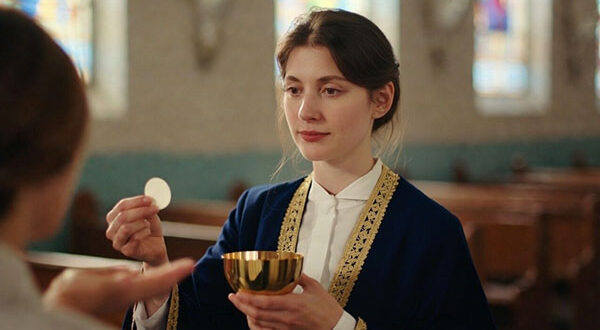
There are topics in the life of the Church that, without making noise, have gradually transformed the liturgical experience of millions of faithful. One of them is that of women (and men) extraordinary ministers of Holy Communion. For many, their presence is something normal; for others, a source of confusion; and for not a few, an open liturgical wound that calls for healing, clarity, and fidelity to Tradition.
This article does not seek to inflame sterile controversies, but rather to educate, enlighten consciences, and offer a serious theological and pastoral guide, accessible and deeply Catholic, to understand what women ministers of Communion truly are, when they make sense, when they do not… and what abuses have been committed in the name of a poorly understood “necessity.”
1. What a Woman Minister of Communion Is — and Is Not
The Church speaks with precision: they are not simply “women ministers of Communion,” but extraordinary women ministers of Holy Communion. The adjective is not decorative. It is theologically decisive.
Ordinary ministers of Communion
They are:
- The bishop
- The priest
- The deacon
Through the sacrament of Holy Orders, they receive an ontological configuration to Christ the Head. They do not “assist” the Eucharist: they act in the name of Christ.
Extraordinary ministers
They are lay faithful — men or women — appointed for a specific service, when there is a true necessity:
- Lack of ordained ministers
- A very large number of faithful that would make the celebration excessively long
- Care of the sick when no priest or deacon is available
The Church is clear: what is extraordinary must not become habitual.
2. A Brief Historical Overview: Have They Always Existed?
No. For centuries, the distribution of the Eucharist was exclusively the competence of the clergy. Not because of clericalism, but because of sacramental awareness: the one who touches, distributes, and safeguards the Body of Christ must be sacramentally configured for it.
The recourse to extraordinary ministers became widespread after the Second Vatican Council, especially from:
- Immensae Caritatis (1973)
- The expansion of frequent Communion
- The decline of priestly vocations in certain places
The original intention was pastoral and prudent. The problem came later.
3. Theological Relevance: The Eucharist Is Not “Something,” It Is Someone
Here lies the heart of the matter.
The Church believes — and proclaims — that in the Eucharist Christ is really, truly, and substantially present. It is not a symbol. It is not a memory. It is not blessed bread.
“He who eats my flesh and drinks my blood has eternal life” (Jn 6:54).
Therefore:
- The way it is distributed matters
- Who distributes it matters
- The interior and exterior attitude matters
When the extraordinary ministry is trivialized, the Eucharistic faith is trivialized — even if unconsciously.
4. Women and the Eucharist: Clarifying Without Confusing
It is essential to say this clearly and with charity.
The fact that a woman can be an extraordinary minister of Holy Communion has nothing to do with the female priesthood, which the Church has definitively declared impossible (Ordinatio Sacerdotalis, Saint John Paul II).
Women in the Church:
- Have equal dignity
- An irreplaceable mission
- An immense spiritual role
But equality does not mean identity of functions. Confusing lay service with ordained ministry is a serious theological distortion.
5. When Abuse Begins: The Extraordinary Turned into the Norm
Here we enter delicate but necessary territory.
Common abuses today
- Women ministers of Communion at Masses where several priests are present
- Systematic use without true necessity
- Replacement of the priest out of “convenience” or speed
- Distribution of Communion as a “functional distribution”
- Lack of doctrinal and spiritual formation
- Inappropriate dress or irreverent attitudes
- Self-perception as a “stable liturgical minister” as if it were a right
All of this is not a minor detail; it is a liturgical abuse.
Redemptionis Sacramentum is blunt:
“This ministry is truly extraordinary and supplementary” (n. 151).
6. Spiritual Consequences of Abuse
When the extraordinary becomes normalized:
- The difference between the ministerial priesthood and the common priesthood is obscured
- Faith in the Real Presence is weakened
- The sense of the sacred is lost
- A “functional,” not adoring, liturgy is passed on to the young
- An unintended Protestantizing mentality is fostered
The liturgy always educates. Always. For good or for ill.
7. Practical Theological and Pastoral Guide (Rigorous and Clear)
For lay faithful
✔ Accept the mandate only if there is true necessity
✔ Demand and receive solid doctrinal and liturgical formation
✔ Live the service with fear of God and profound humility
✔ Dress and act with maximum reverence
✔ Renounce the service if it is no longer necessary
“He must increase, but I must decrease” (Jn 3:30)
For priests and pastors
✔ Do not delegate out of convenience
✔ Promote a slower and more reverent liturgy, not a more efficient one
✔ Catechize on the meaning of the ministry
✔ Avoid the “clericalization of the laity”
✔ Guard the Eucharist as the greatest treasure of the parish
For parish communities
✔ Do not demand extraordinary ministers “because it has always been done this way”
✔ Recover silence, adoration, and wonder
✔ Educate in reverent waiting, not in haste
✔ Promote priestly vocations, not permanent stopgaps
8. Recovering Wonder: An Urgent Call
The deeper problem is not women ministers of Communion.
The deeper problem is the loss of the sense of Mystery.
When the Eucharist ceases to be the burning center of Christian life, everything becomes relative. When it regains its place, every gesture, every ministry, and every silence is properly ordered.
“Treat holy things in a holy manner” (cf. Lv 10:3)
Conclusion: To Serve, Yes — To Substitute, No
Extraordinary service can be legitimate, useful, and holy.
But only when it is truly extraordinary.
The Church does not need more “functions,” but adoring hearts.
She does not need to multiply ministers, but to deepen the Mystery.
She does not need speed, but reverence.
May Mary, the Eucharistic Woman par excellence, teach us to touch Christ with the soul before touching Him with the hands, and never to appropriate what belongs to God alone.
Because before the Eucharist, we are not protagonists.
We are adorers.


