Related Articles
In an age where almost everything is measured by comfort, speed, or efficiency, the body has also lost its sacred language. Many faithful no longer know when they should kneel at Mass; others do so out of habit; some deliberately avoid it; and not a few wonder whether it is “still necessary.”
The question is not a minor one: when should I kneel and when should I not kneel at Holy Mass?
Because in the liturgy nothing is neutral. Every gesture, every bodily posture, is a silent confession of faith… or of its absence.
This article seeks to be a clear, deep, and pastoral guide for today’s believers who wish to live the Mass with greater awareness, reverence, and love. Not from rigidity, but from truth. Not from imposition, but from understanding.
1. The body also believes: the theology of gestures
Christianity is not a religion of abstract ideas, but of flesh and blood. God became flesh. And therefore the body prays.
Bodily posture is not an external add-on to faith, but a visible expression of an interior attitude:
- Standing expresses respect, attentiveness, readiness.
- Sitting indicates listening, receptivity, meditation.
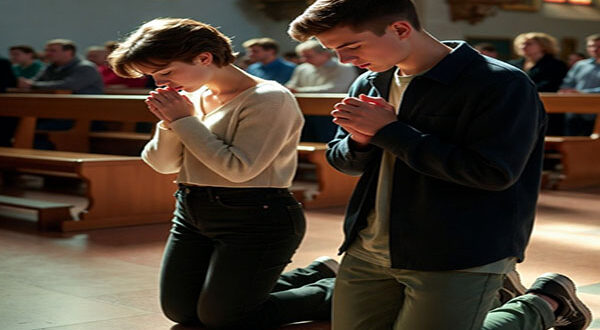
- Kneeling signifies adoration, humility, and recognition of God’s absolute sovereignty.
Sacred Scripture is crystal clear:
“At the name of Jesus every knee should bow, in heaven and on earth and under the earth.”
(Philippians 2:10)
Kneeling is not a medieval gesture, nor an outdated cultural tradition. It is a deeply biblical and Christological act.
2. Kneeling in the Bible: when man acknowledges God
From the Old Testament to the Gospel, kneeling always appears linked to an encounter with the divine.
- Solomon kneels to pray in the Temple (1 Kings 8:54).
- The psalmist proclaims: “Come, let us bow down in worship, let us kneel before the Lord who made us” (Psalm 95:6).
- The Magi prostrate themselves before the Child God (Matthew 2:11).
- The leper kneels before Jesus to beg Him (Mark 1:40).
- Jesus Himself kneels in Gethsemane (Luke 22:41).
Kneeling is always an act of truth: recognizing who God is… and who I am.
3. The tradition of the Church: centuries of faith lived on one’s knees
For centuries, kneeling was the habitual posture in the Latin liturgy at the most sacred moments of the Mass.
Not out of ritualistic obsession, but out of a deep conviction:
👉 God is truly present on the altar.
Especially with the development of Eucharistic doctrine, the Church understood that bodily adoration was the most logical response to the Real Presence of Christ in the Blessed Sacrament.
Kneeling was not seen as humiliation, but as a privilege: the gesture of the subject before his King, of the child before his Father, of the creature before his Creator.
4. What does the Church say today? Current liturgical norms
According to the General Instruction of the Roman Missal (GIRM), valid today for the Ordinary Form of the Roman Rite, the faithful should kneel at these key moments:
🔔 1. During the consecration
From the epiclesis (the invocation of the Holy Spirit) until after the elevation of the chalice.
👉 This is the central moment of the Mass. Christ becomes truly present: Body, Blood, Soul, and Divinity.
Kneeling here is not optional, except in cases of physical impediment or a legitimate directive from episcopal authority.
🔔 2. Before Communion (Agnus Dei, in many places)
Traditionally, the faithful remain kneeling during the “Lamb of God,” as a gesture of humility before the mystery they are about to receive.
🔔 3. In adoration of the Blessed Sacrament
Outside of Mass, kneeling before the exposed Blessed Sacrament is the proper gesture of Eucharistic adoration.
5. When should I NOT kneel?
The liturgy also teaches that not everything is kneeling. Each posture has its place.
❌ One does not kneel:
- During the readings: one listens while seated.
- During the Gospel: one stands, as a sign of respect for Christ who speaks.
- During the Creed and the Prayer of the Faithful: one stands, professing and supplicating.
- During the Our Father: the posture of children who pray with confidence.
- After Communion: the Church recommends silence and recollection, seated or kneeling, according to personal devotion.
The liturgy is not monotony; it is a living dialogue between God and His people.
6. What if I cannot kneel?
Here pastoral charity comes into play.
The Church never obliges what is impossible:
- Elderly persons
- The sick
- Those with mobility problems
Those who cannot kneel physically do not sin nor show disrespect. God sees the heart.
But attention: being unable is not the same as being unwilling.
When the impossibility is real, one may:
- Make a deep bow of the head
- Keep reverent silence
- Adopt a dignified and recollected bodily posture
7. The current crisis: when no longer kneeling reveals something deeper
Today many churches have removed kneelers. Many faithful no longer kneel even during the consecration. And this is not accidental.
Where the gesture is lost, faith in the Real Presence weakens.
This is not an accusation; it is a pastoral observation. When the body ceases to adore, the soul often follows.
Kneeling evangelizes without words. It teaches children. It challenges the lukewarm. It reminds the distracted that they are before a Mystery.
8. Practical theological and pastoral guide
✔ Kneel when:
- Bread ceases to be bread and wine ceases to be wine.
- Your heart needs to remember who is in command.
- You want to teach others without saying a word.
- Faith falters and the body can help the soul.
✔ Remain standing when:
- You profess your faith.
- You listen to Christ speaking.
- You pray as a child of God.
✔ If you are in doubt:
👉 Reverence is never excessive.
👉 Adoration is never exaggerated.
9. Kneeling is not going backward; it is returning to the center
Kneeling at Mass is not nostalgia, nor ideology, nor rigidity. It is theology made flesh.
It is saying with the body what the mouth sometimes no longer dares to confess:
“My Lord and my God” (John 20:28)
Perhaps the greatest countercultural act today is not to shout, argue, or impose…
but to bend the knee in silence before God.
Because whoever kneels before God does not kneel before the world.